
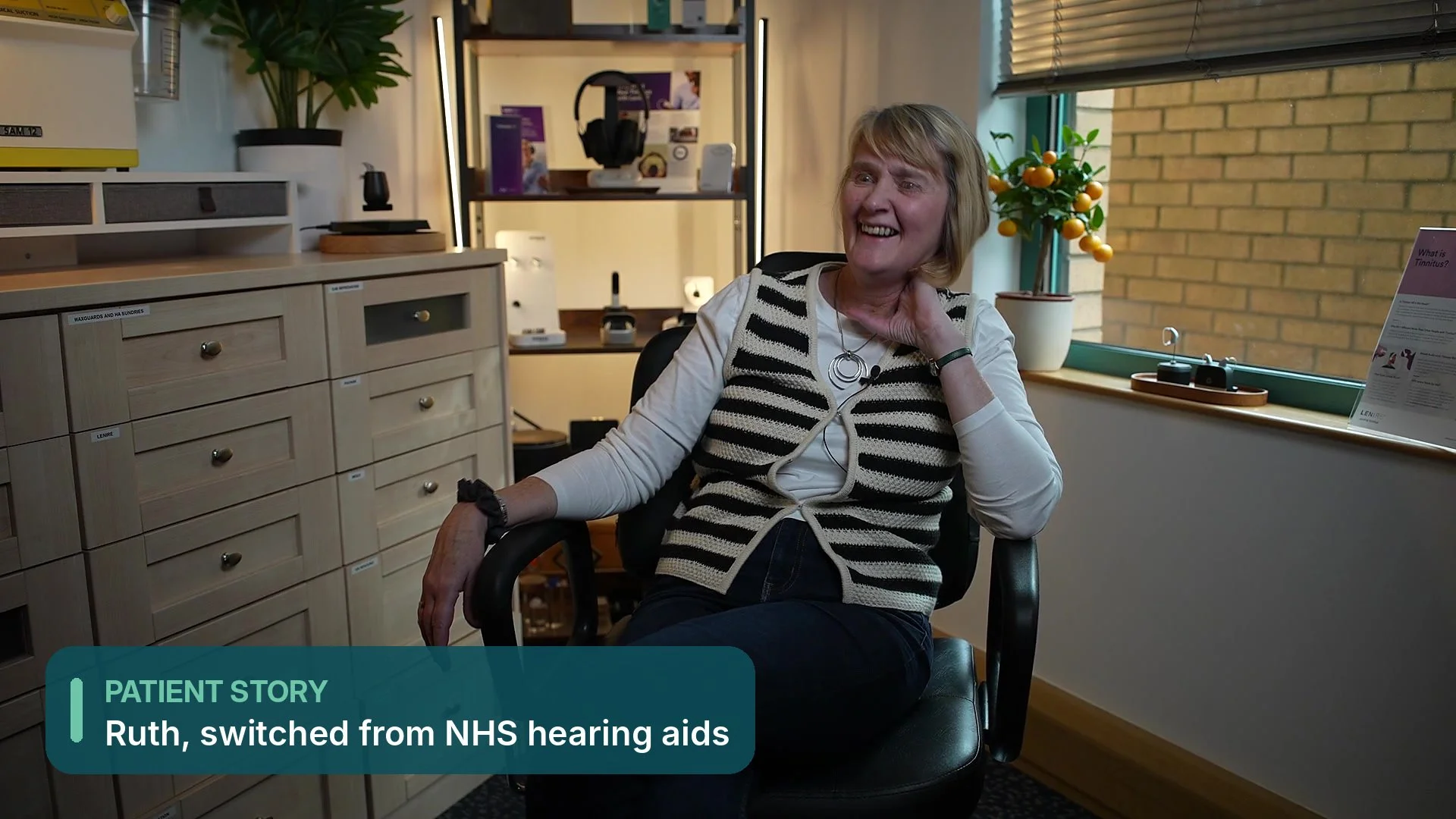
Came to us with: hearing loss diagnosed ten years ago, NHS hearing aids with very little follow-up, and a growing habit of avoiding coffee shops, crowds and anywhere with background noise.
What we did: an unhurried first appointment that started by listening, hearing aids chosen for the situations she was avoiding, and three or four visits over six weeks to fit the service to her.
Now: "A lot of the time I don't even think about my hearing." Ruth went to the crowded church event she'd have skipped, and calls it the best money she's spent.
Ruth was diagnosed with hearing loss about ten years ago. She had found social situations increasingly hard, especially anywhere with a noisy background, and coffee shops in particular. The health service provided hearing aids, and as she remembers it, that was more or less the end of the process. "I was sent off with my hearing aids and my pack of batteries, and that was it." In the same situations as before, she was struggling more and more. It was her husband who saw how much it was costing her. "He was very aware of how much my hearing loss was really starting to impact my life." They talked it through and decided to explore the options, and at least find out what it would involve.
What Ruth describes about her first visit is less about equipment than about being heard. The clinic was relaxed and comfortable, there was no time pressure, and she was asked how the hearing loss was affecting her before anything else. "The ease of access and the comfortable environment, and actually being listened to, was a huge thing for me." Over about six weeks she was seen three or four times, each visit adjusting the aids and the settings to what she needed rather than to a standard programme. She also describes something the first fitting had lacked: an open door. "I always felt that I could go back or get in touch at any point if I came up against a problem or needed more support."
The moment she remembers came soon after. There was an event at church with a large crowd, the kind of thing she had already decided wasn't worth attempting. "Prior to getting my hearing aids I had thought, there's no point in me going to this, I'm not going to be able to hear what people are saying." After a few weeks with the new aids she went, and found she could cope, relax, and enjoy it. Her summary is plain. "To be honest it's the best money I've spent, and it has made such a massive difference to my life. My hearing was a massive ongoing daily issue, but now it's not really an issue at all."
“To be honest, it’s the best money I’ve spent, and it has made such a massive difference to my life. I mean, a lot of the time I don’t even think about my hearing now.”
Questions that Ruth’s story answers
Can I switch from NHS hearing aids to a private audiologist?
Yes, and you keep your NHS aids; nothing about your NHS care changes. A private assessment looks at your hearing and, just as importantly, at the situations where you still struggle. If a different device or a different fitting would help, we say so; if your current aids could be made to work better, we say that instead. The hearing test is free for over 60s and £70 for under 60s.
What is the difference between NHS and private hearing aids?
NHS hearing aids are good devices and free, and for many people they are enough. The differences are usually in what surrounds the aid: how much time the fitting gets, how often it is reviewed, how closely it is tuned to the places you actually go, and the range of devices on offer, including a wide range of brands, smaller, rechargeable, custom in-the-ear hearing aids and phone-connected models. What Ruth describes, being handed the aids and a pack of batteries with little follow-up, is the gap most people mean when they ask this question.
What happens after a hearing aid fitting at Hear Now Clinic?
We don't fit and forget. After the fitting we see you fortnightly for eight weeks and adjust the hearing aids to the places you actually struggle, whether that is a coffee shop, a church hall or a family meal. Ruth's three or four visits over six weeks, and the open door afterwards, are what that looks like in practice.
-
“Well, I was diagnosed with hearing loss about ten years ago now. I had found it increasingly difficult in social situations, noisy backgrounds, coffee shops and so on, and then I was provided with hearing aids by the health service. As I recall there was really very little follow-up, let's say. So I was sent off with my hearing aids and my pack of batteries, and that was it, more or less. I just noticed, in the same situations as before, I was struggling more and more. My husband and myself, we talked about it, and he was very aware of how much my hearing loss was really starting to impact my life. So we talked about it and we decided we'd explore the options and at least see what it would involve.
To come to Hear Now, I was able to be seen in a way that suited me. It was a relaxed clinic, it was comfortable, you felt there was no time pressure. I was actually talked to about how it was impacting me. I would say the ease of access and the comfortable environment, and actually being listened to, was a huge thing for me when I came to the clinic first.
Over a six-week period I was seen, I think it was three or four times. It was very much a question of fitting the service to suit me, what I needed. And I always felt that there was a sort of an open door, that I could go back or get in touch at any point if I came up against a problem or needed more support.
I remember, just about the time that I got my hearing aids, there was an event at church that was happening with quite a large crowd of people. I really wanted to go to it, but prior to getting my hearing aids I had thought, you know what, there's no point in me going to this, I'm not going to be able to hear what people are saying. And after working with my new hearing aids I thought, do you know what, I'm going to go to this. And it gave me the confidence to go into that environment knowing that I would be able to cope, and I was able to really enjoy the event and start to relax in that environment.
To be honest, it's the best money I've spent, and it has made such a massive difference to my life. I mean, a lot of the time I don't even think about my hearing now. My hearing was a massive ongoing daily issue in my life, but now it's not really an issue at all.”
Isaac Thompson BSc is an HCPC-registered audiologist and co-owner of Hear Now Clinic, an independent audiology clinic in Belfast, Templepatrick and Carryduff.
