
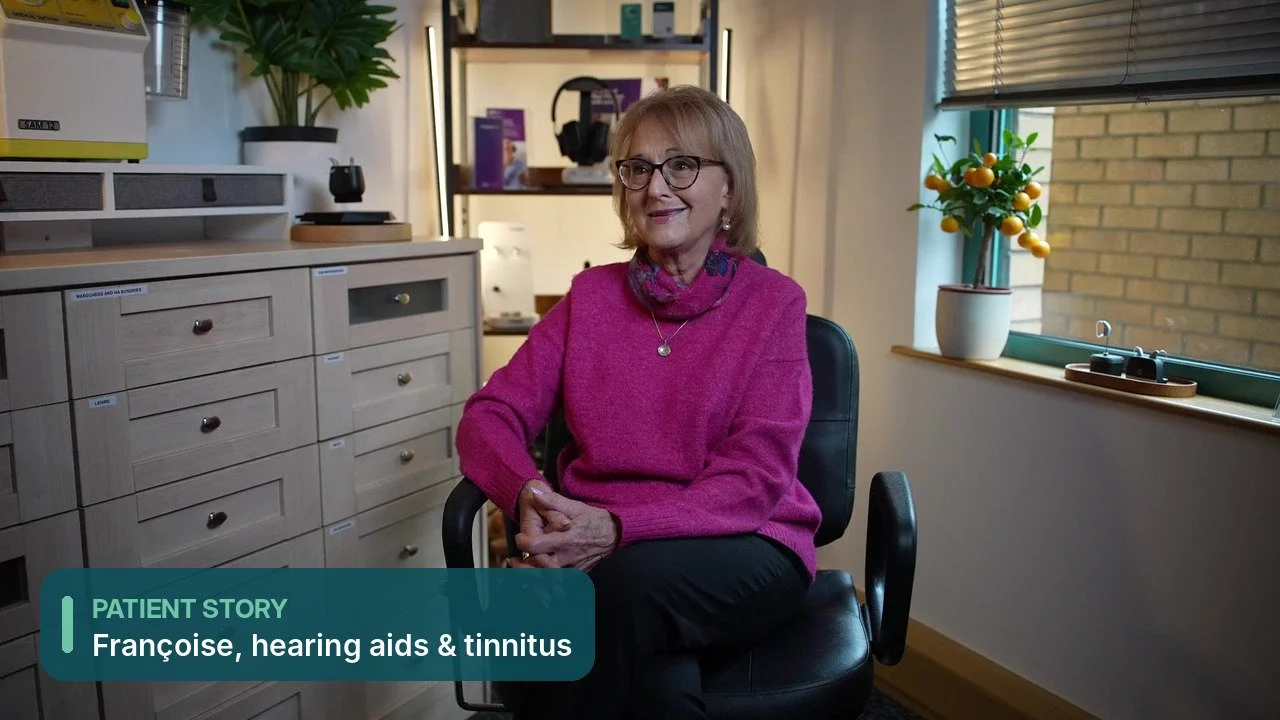
Came to us with: years of struggling to hear, especially on the right, then dizziness, a feeling of fullness in the ear and a diagnosis of Ménière's disease. She describes her tinnitus as a constant whooshing sound.
What we did: a first appointment that started by listening, a hearing aid fitted to her loss, and a review every two weeks so nothing waits.
Now: "I can hear so much better." The whooshing is practically gone when she wears the aid, and she says she can't wait to put it in every morning.
Françoise had struggled with her hearing for several years, and it was worse on the right side. Out with friends, she began to dread being asked her opinion, because she had no idea what the conversation was about. "You pretend that you've heard the question," she says, "and you hope that your answer will be fitting." It made her feel lonely, and in the end she found excuses not to go out at all. Then came dizziness and a growing feeling of heaviness in the ear, and with it a diagnosis of Ménière's disease, a condition of the inner ear that brings episodes of vertigo, a fluctuating hearing loss and tinnitus. She was told there is no cure. What she took from that was that she couldn't wait any longer, and she went looking for an audiologist.
A friend had been to Hear Now Clinic and told her they were brilliant and had looked after her well. What Françoise remembers about her first visit is being put at ease. Isaac asked questions, was patient, and let her talk about how she felt physically and emotionally before anything else happened. "I felt that you were really invested in your patients." The part she singles out is the aftercare. Her hearing aid is reviewed every two weeks, which matters more than usual with Ménière's because the hearing loss can change between visits. "I know that if there is a problem I don't have long to wait until I'm seen again."
The result went beyond hearing. "I was so used to having this whooshing sound constantly in my ear. I couldn't believe that once I wore the hearing aid it was practically gone." Restoring sound to an ear that has been missing it often reduces how much the brain notices tinnitus, and for Françoise the difference was immediate.
Her advice to anyone who thinks they might need a hearing aid: "Go and find out if it's for you. It has changed my life for the better and I wouldn't be without it now.
“I was so used to having this whooshing sound constantly in my ear. I couldn’t believe that once I wore the hearing aid it was practically gone”
Questions that Françoise’s story answers
Can hearing aids help with tinnitus?
Often, yes. Tinnitus is usually more noticeable when the ear is sending less sound to the brain, so restoring that input with a well-fitted hearing aid reduces how much the brain attends to the ringing or whooshing. It is not a cure and it does not work for everyone, which is why we assess the hearing loss and the tinnitus together before recommending anything.
Can you wear hearing aids if you have Ménière's disease?
Yes, and many people with Ménière's benefit from them. The challenge is that the hearing loss can fluctuate, so a setting that was right one month may not be right the next. That is why regular reviews matter more than usual: the aid is re-tuned to where your hearing actually is, not where it was at the first fitting.
What happens after a hearing aid fitting at Hear Now Clinic?
We don't fit and forget. After the fitting we see you fortnightly for eight weeks and adjust the hearing aid to the places you actually struggle, and for a changing condition like Ménière's we keep reviewing after that. Françoise says knowing she never has long to wait is the part that made the difference.
-
“Well, I've struggled with my hearing for quite a few years now. I realised that I just couldn't hear, especially in my right ear. If I was going out with my friends I was actually afraid that they might ask me for my opinion on whatever they were discussing, because I didn't have a clue what they were talking about. In the end you pretend that you've heard the question and you hope that your answer will be fitting to what they want you to say.
It makes you feel very lonely. And in the end I'd even find excuses not to go out. Eventually I felt dizzy. This feeling of heaviness in my ear got worse, and that's when I was diagnosed with Ménière's disease, which is a disease of the inner ear. And apparently there is no cure for it. I just knew I couldn't wait any more.
So that's when I decided to go and look for an audiologist. And I found you because one of my friends had come here, and they said to me, look, they are really brilliant, they looked after me so well. The first time I came to the Hear Now Clinic I was greeted by Isaac, who really put me at ease straight away. He asked me questions, he was patient with me, he let me talk about how I felt physically and how I felt emotionally. I was really impressed. I felt that you were really invested in your patients.
One thing which is really brilliant with Hear Now Clinic is the aftercare. Isaac reviews my hearing aid every two weeks. I know that if there is a problem I don't have long to wait until I'm seen again. I can hear so much better. And it's actually helped with the tinnitus as well. I was so used to having this whooshing sound constantly in my ear. I couldn't believe that once I wore the hearing aid it was practically gone.
I can't wait to put it in every morning. And I would say to anyone who feels that they need a hearing aid: go and find out if it's for you. I can say that it really has changed my life for the better and I wouldn't be without it now. And I can also recommend the Hear Now Clinic, because to me the service that I got is second to none.”
Isaac Thompson BSc is an HCPC-registered audiologist and co-owner of Hear Now Clinic, an independent audiology clinic in Belfast, Templepatrick and Carryduff.
